Report for November 2004
Annualized Return (IRR): 7.6% YTD and 9.0% since Oct. 5, 2000
Summary Report | PERT | Trend Report | Offense Report | Defense Report
At the end of November, the Moose Pond Investors’ portfolio had the following weighted averages: projected total return of 21.4%, projected average return of 14.7%, upside / downside ratio of 4.1 to 1 and a relative value of 91.8. These are all very good averages. The portfolio has 7.6% of its assets in cash.
Johnson & Johnson (JNJ)
Current SSG and PERT A (11-29-2004) | Google: “Stocks: JNJ” | Company Website
 Stock Selection Guide Updated. The SSG for Johnson & Johnson has been revised. JNJ remains a high quality company and is within the “buy” range.
(more…)
Capital One Financial
Stock Selection Guide Updated. The SSG for Capital One Financial has been revised. Capital One Financial remains a quality company. The stock has moved just out of the “buy” range into the “hold” range.
There is a replay of an informative presentation by the Capital One Financial CEO at the Merrill Lynch Banking & Financial Services Conference on November 15 available at the company website. If you listen to the presentation, be sure to view the presentation slides. The presentation explains the strategic direction of Capital One Financial.
(more…)
Amgen Inc.
 Stock Selection Guide Updated. The SSG for Amgen has been updated. 5-year EPS was projected using the “preferred procuredure” with the following assumptions: revenue growth of 15%, pretax margin 40.4%, tax rate of 26.5% and outstanding shares of 1,175 million. This results in a projected average return of 13.9% using an averate high PE of 29 and average low PE of 16.5. This puts Amgen in the “buy” range. Both IAS and First Call’s analysts consensus project growth at 20%, so the 15% projected growth used in the SSG is conservative.
For the fifth time, Amgen has been named one of the “100 Best Companies to Work for in America” by Fortune magazine. Also, Amgen ranked fifth in The Scientist’s annual survey of the best workplaces for 2004. Details. Amgen also has an excellent website for investors.
From December 2004 Investor Advisory Service by IClub: IAS also has Amgen in the “buy” range. “Amgen reported continuing solid results for the third quarter of 2004 with total product sales up 23%. On an adjusted basis, excluding one-time factors relating to the company’s acquisition of Tularik, earnings per share growth was 39%. The company also increased guidance for expected earnings per share for the year from about $2.35-$2.40. The sales guidance was also improved to about $10.4 billion for the year. While the company is dependant on a limited number of products, these have continued to grow and sell well. There are also a number of interesting new possibilities in the process of development. Certainly Amgen is the most successful of the world’s biotech companies. AMGN (59.87) is a buy up to 82.”
(more…)
Affiliated Computer Svc
Affiliated Computer Services (ACS)
SSG and PERT A (11-24-2004) | Google “Stocks: ACS” | Company Website
The Affiliated Computer Services stock selection guide has been updated. Here are the highlights.
 Quality. Section 1 of the SSG (the graph on page one), shows consistent growth. For ACS, the correlation coefficient (r^2) is 1.0 for earnings and .95 for sales. This is quite good. Looking at Section 2 of the SSG, the pre-tax profit margin is trending up and return on equity is even. These are both indicators of consistency and excellent management. Overall, ACS is a high quality company.
Growth. Historically, ACS has had very strong growth. It is a little tricky to estimate future ACS growth since recent financial statement reflect the divestiture of most of ACS’ government business and the acquisition of some new businesses. The management discussion in the current 10Q discusses internal revenue growth (measured as total revenue growth less acquired revenue from acquisitions and revenues from divested operations). After excluding the impact of the revenues related to the 2004 divestitures, revenues in the current quarter increased 22%. Internal revenue growth accounted for 11% of the 22%. The above SSG uses a revenue growth of 15.8% based on Value Line.
Valuation. Using the “preferred proceed” in the SSG, the projected 5-yr EPS is $5.88. (See SSG for pre-tax margin, tax rate and shares outstanding.)
The projected average return over five years is 14.5%. Here is how it is calculated:
- Projected 5-yr Price = Projected P/E * Projected EPS Projected 5-yr Price = 19.9 * 5.88 = $117.02Projected Avg Return = [(Future Price / Current Price)^(1/5) + Avg Div Yld – 1] * 100
Projected Avg Return = [(117.01 / 59.53) ^ (1/5) – 1] * 100 = 14.5%
Note: The Toolkit software does this automatically. Reviewing the calculations makes it easier to understand the results.
Summary. ACS (currently $59.53) is in the “buy” range. The upside-downside ratio is 3.9 to 1. The relative value is 100.
(more…)
Portfolio “Rack and Stack”
 To borrow a military expression, I thought it might be helpful to “rack and stack” our portfolio. We should do this at least quarterly, if not more frequently. It is fairly easy to do with the computer. The attached spreadsheet contains key portfolio management metrics.
Out of our 22 stocks, 14 are still in the “buy” range. We have selected good stocks because a number of these stocks have appreciated in price but are still considered “buys”. Our all time winners are LOW (+205%) and JCI (+143%). The other 7 stocks are slightly out of the buy range but are definite “holds.”
In managing a portfolio, we try to identify stocks that no longer meet our objectives (including future earnings prospects) or have declined in quality. We should replace those stocks. There are other factors to consider as the NAIC web article on when to sell points out, but these two are the primary factors.
We should compare stocks in the portfolio to see whether it is possible to replace a low quality stock with a higher quality stock and/or replace a stock with a relatively low projected return with a stock with a higher projected return. Our current portfolio looks fairly good in terms of quality and projected return. I don’t see any immediate candidates for replacement but we need to continue watch closely and reevaluate each quarter.
We can compare relative value and upside downside ratios to see if any stocks in the portfolio have become overvalued. We don’t appear to have any in the overvalued category now.
We also need to look at sector and industry diversification. (Sectors are made up of related industries.) We are diversified across four sectors. We also are diversified by industry within each of these four sectors. Our size diversification breaks down as follows: 42% in large companies, 45% in medium companies and 5% in small companies. (This doesn’t add up to 100% because we also have a small position in a NASDAQ 100 index fund.) We probably ought to be looking harder for small companies.
A final “rack and stack” consideration is how much each stock represents of the total portfolio value. In our portfolio the average stock is valued at a little more than 4% of the total value of the portfolio. This type of diversification protects our overall portfolio return by limiting the damage any one stock can do to the overall portfolio return. A stock that drops in value by 50% will only reduce total portfolio return by about 2%.
Hope these comments are helpful.
Marsh & McLennan Cos.

Initial Position in Marsh & McLennan. On November 10, Moosepond Investors bought took an initial position in MMC. The stock selection guide assumes a 9% earnings growth rate and an average high PE of 18. MMC has been in the news recently. The current investigation by the New York State Attorney General into commission practices by the insurance industry and an allegation of bid rigging has caused the MMC’s stock price to drop from $46 per share to its current levels in the high $20s. This presents an excellent buying opportunity, but not one without risk. The October 26 press releases and webcasts on the MMC website give some assurance that management is aggressively working to resolve the issues raised by current investigation. By all traditional measures, MMC remains a high quality company. It remains to be seen whether the investigation will result in a loss of revenue to MMC be customer defection or a reduction in earnings as a result of changed commission practices.
(more…)
Education Management Corp.

A Company to Consider Buying. Education Management Corporation (EDMC) provides private post-secondary education in North America. EDMC delivers education to students through traditional classroom settings as well as through online instruction. Its educational institutions offer a broad range of academic programs concentrated in the following areas: media arts, education, design, information technology, fashion, Law and legal studies, culinary arts, business, psychology and behavioral sciences, and health sciences. It offers academic programs through four educational systems: The Art Institutes; Argosy University; American Education Centers; and South University.
EDMC acquired AEC and South University during fiscal 2004. As of June 30, 2004, EDMC had 67 primary campus locations in 24 states and two Canadian provinces. Its program offerings culminate with the award of degrees ranging from associate’s to doctoral degrees. It also offer non-degreed programs, some of which result in the issuance of diplomas upon successful completion. Prior to fiscal 2004, The Art Institutes and Argosy University were managed as separate operating segments. During the first quarter of fiscal 2004 we shifted from an educational system approach to a centralized corporate structure utilizing divisions which have been aggregated into one operating segment. EDMC currently has three distinct operating divisions organized by geographic location within North America: the Eastern Division; Central Division; and Western Division.
Looking at the Stock Selection Guide
Quality. Look at Part 1 of the SSG. EDMC has had consistent growth in revenues and earnings over the past seven years. Value Line rates its earnings predictability 100 (out of 100) and its financial strength a “B+”. Section 2 of the SSG shows pretax profit on sales as 13.8% (5-year average) and trending up slightly. ROE is up over the last three years but slightly below the 5-yr average.
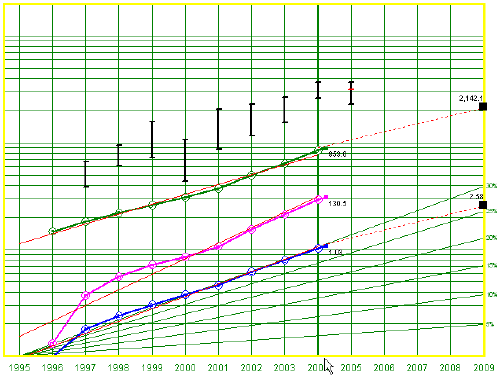
One caution is that EDMC has not done as well as its industry competitors over the past five years on return on equity (18.0 vs. 21.9) or net profit margin (8.3 vs. 12.7). Also, it would be better if Value Line financial strength were a B++ or higher. Overall, EDMC is a quality company.
Growth. Value Line projects EPS growth at 21.5 (based on revenue growth of 21.5. Reuters projects EPS growth of 20% (based on 7 analysts). Morningstar also projects 20% growth (based on 11 analysts).
Projected EPS in Five Years. The SSG uses EPS growth RATE of 19%. Resulting in a 5-yr EPS of $2.58. Here is the formula for 5-yr EPS using the trailing twelve months (TTM) EPS of $1.08 and projected growth rate of 19%: [2.58 * (1.19)^5]. Using the “preferred procedures on the SSG (assuming 19% revenue growth, 15% pretax profit margin (Value Line 17.6%), 40% tax rate and 78M shares outstanding, projected 5-yr EPS is 2.47.
Average High and Low PE. The SSG uses an average high PE of 28.5. This PE is 1.5 times the 19% projected growth rate (1.5 * 19 = 28.5). The current PE is 27.3. Relative value of 106.2 and projected relative value is 89.1. Since EDMC is fairly priced relative to its historic PE, gains form PE expansion are unlikely.
Projected 5-year Return (Annualized). Using the data from above, total return for EDMC is 20.1% and projected average return (PAR) is 15.7%. The upside-downside ratio is 4.4.
Bank of America
Bank of America (BAC) is the stock to study in the November 2004 edition of Better Investing magazine. Here is the presentation (470 kb) on BAC given to the NAIC DC Chapter on November 9, 2004. Related files include a SSG and PERT (480 kb) and a presentation (480 kb) presented by Bank of America investor relations personnel at the NAIC Better Investing National Conference this week.