Quality Growth Screen
Here is a Quality Growth Screen using Value Line data. Projected average return was calculated from Value Line data in two ways One calulation sued projected EPS growth, the other used projected sales growth.
Evaluating Energy Stocks
Energy stocks are difficult to assess. The standard NAIC growth stock methodology does seem not work particularly well with energy companies since their revenues are driven in part by the pricing of the underlying commodity (oil or gas).
Kurt Wulff maintains the “McDeb” website which contains a weekly analysis of energy stocks. He was written up in Barrons earlier this year.
He has developed the McDep ratio which compares a company’s market value and debt to its present value. (“McDep” stands for market cap and debt to present value.) The ratio provides a useful way to compare energy companies and to assess relative market valuation.
In addition to preparing a weekly analysis called the “Meter Reader,” Kurt Wulff also profiles individual energy companies.
The site is free and does not require registration. The information on the site lags a week or two from when he provides it to his paying clients.
ChevronTexaco has a projected average return (PAR) of 10.4% and a quality rating of 64. More importantly, CVX has a McDep ratio of 0.77. This means that CVX is undervalued. A ratio of 1.0 would mean that ChevronTexaco’s market value and debt equaled its its present value. This McDep ratio calculation assumes $37 bbl oil. (This is a conservative assumption since futures contracts over the next six years are currently priced at $51 bbl.) See Wulff’s assessment of ChevronTexaco.
FactSet Research Sys (FDS)
SSG and PERT A | Google Stocks | Company Website
 5/7/2007: The SSG has been updated. FDS has been a winner. However, its run-up in price has reduced projected average return (PAR) to about 6%. If PAR falls any lower, it might be candiate for replacement. ValueLine rates its financial strength B++ and earnings predictability 100. Morningstar rates it three stars. See stock selection guide. (more…)
Cardinal Health Inc. (CAH)
SSG and PERT A (04-23-2005) | Google Stocks | Company Website
 This is an update of the SSG for Cardinal Health. CAH is a buy.
(more…)
Teva Pharmaceutical Ind.
The April 2005 Better Investing magazine featured Teva Pharmaceutical Industries as a stock to study. Here is a PowerPoint presentation and stock selection guide analyzing Teva.
Here is the bottom Line: TEVA is a good quality stock. Value Line financial strength is A but earnings predictability is only 55, RQR is 58.5. It currently has an upside/downside ratio of 4.3 and a relative value is 106. It has an estimated total return of 20.4% (assuming a 5-yr high PE of 24.8) and projected average return of 16.0%.
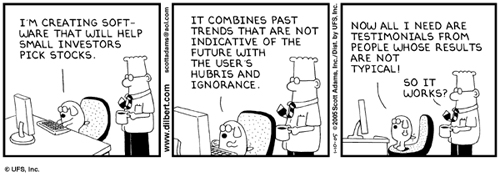
Portfolio Summary Updated
The portfolio summary and quality growth screen have been updated. The Moose Pond portfolio is diversified across eight industries.
Bed, Bath & Beyond (BBBY)
SSG and PERT A (04-01-2005) | Google Stocks | Company Website
 Stock Selection Guide Updated. The SSG for Bed, Bath & Beyond has been revised. BBBY remains a high quality company and is within the “buy” range up to a price of $44.90.
There is an excellent article by Mark Robertson at www.fundas.com discussing Bed, Bath and Beyond. His analysis is right on target.
On April 6, BBBY reported its year end results. Sales were up 15% and net earnings increased 26.4%. This shows very positive growth and is in line with past years. Comparable store sales increased by 5.1%.
(more…)
Berkshire Hathaway
The annual reports for Berkshire Hathaway include Warren Buffet’s letters to shareholders. In addition to discussing the state of the company, these letters contain sage investment advice applicable to all investors, including small investors. Here is an excerpt from this year’s letter.
Over the 35 years, American business has delivered terrific results. It should therefore have been easy for investors to earn juicy returns: All they had to do was piggyback Corporate America in a diversified, low-expense way. An index fund that they never touched would have done the job. Instead many investors have had experiences ranging from mediocre to disastrous.
There have been three primary causes: first, high costs, usually because investors traded excessively or spent far too much on investment management; second, portfolio decisions based on tips and fads rather than on thoughtful, quantified evaluation of businesses; and third, a start-and-stop approach to the market marked by untimely entries (after an advance has been long underway) and exits (after periods of stagnation or decline). Investors should remember that excitement and expenses are their enemies. And if they insist on trying to time their participation in equities, they should try to be fearful when others are greedy and greedy only when others are fearful.