Amgen Inc. (AMGN)
SSG and PERT A (12-26-2005) | Google “Stocks: AMGN” | Company Website
 Amgen remains a HOLD. Morningstar provides the following summary of Amgen:
Amgen stands out in an industry dominated by companies trying to creep out of the red. With 37% operating margins last year (excluding acquisition-related charges) and historical margins periodically surpassing 40%, Amgen has proved its ability to translate sales into profits. Even though it invested $2 billion in research and development last year, Amgen still generates plenty of cash, with free cash flow solidly above 20% of sales. With these numbers, Amgen is rewarding investors by both funding future growth and repurchasing shares.
Growth. The Value Line 3-5 year growth projection for revenue growth is 18.5% and EPS is 10%. M* only forecasts 15% revenue growth. The attached stock selection guide uses revenue growth of 17%. Using the preferred procedure, this results in EPS growth of 15.5% and a projected 5-year EPS of $5.88.
Quality. AMGN is high quality company with Value Line rating Financial Strength A++ and Earning Predictability 95. Section 2 of the SSG shows average return on equity (ROE) of 16.8% and average pretax margin of 41.6%. The RQR quality rating is 78.2.
Valuation. Applying the above and a conservative future average PE of 23, the projected average return is 10.8% making Amgen a HOLD. M* rates AMNG four stars meaning the stock is under valued.
Investing Philosophy
We invest in quality companies that grow their earnings based on a sound business model. We buy these stocks when they are priced to provide superior long term returns.
While many investors and mutual funds invest in either “growth” or “value” stocks, we
look for companies that have both attributes. Growth, quality, and value are interrelated.
A company should have a sound business model that has demonstrated consistent growth in revenue and earnings over the past 3 to 5 years. The company also should have the potential to sustain growth in revenue and earnings into the foreseeable future.
The quality of a company, which usually reflects strong management, manifests itself in several ways, including: (1) consistent historical growth in revenue and earnings, (2) steady or increasing pre-tax profit margins, (3) steady or increasing return on equity that is greater than the industry median and is generally greater than 15%, and (4) a strong balance sheet.
Value Line ratings of B++ or better for Financial Strength and 85 or better for Earnings Predictability correlate well with quality and good management. We also compare each company’s prospects for future growth and net profit margins with other companies in the same industry. The Manifest Investing quality rating combines these four factors into a single 100 point rating.
Superior long term returns can be assessed in two ways – (1) by calculating intrinsic value for a company using discounted cash flow or (2) estimating the projected average return using a stock selection guide or similar calculation. Using the stock selection guide, we look for a projected average return (PAR) greater than 15%. We also look for quality stocks that sell below their intrinsic value. Morningstar uses a discounted cash flow analysis to determine the fair market (or intrinsic) value of a stock. Stocks rated 4 and 5 stars sell below their intrinsic value. It is generally easier – although not as precise – to compare stocks using their projected average return from the stock selection guide.
We prefer companies that, if purchased, offer the possibility of price earnings (PE) ratio expansion. We generally avoid companies with high PEs, particularly when the PEs have been contracting in recent years. High growth stocks with high PEs are particularly vulnerable to large downward price adjustments if the growth outlook for the company slows down.
Portfolio management is as important, perhaps more important, as selecting good stocks. Several general principles guide our portfolio management:
- Try to stay fully invested and to keep our cash position
below 5%. - Don’t try to time the market.
- Maintain about 20 stocks in our portfolio +/- 5. We reinvest all of our dividends in the companies paying the dividends or in the portfolio.
- Replace a holding if the company’s fundamentals deteriorate or if the company becomes overvalued.
- Replace an individual stock if the replacement company will improve the overall projected average return or the quality of the portfolio.
- Consider diversification when making purchases and try to stay invested in at least five different sectors but there are no strict rules about sector weighting or company size.
The Coiled Spring Effect
Market forces are not always rational. Sometimes, a company continues to grow its earnings but its stock price gets stuck in a rut, trading within the same price range for several years. Earnings continue to grow but the price stays about the same. This phenomenon can be observed in the graph in Section 1 of the stock selection guide and also in the table in Section 3 (falling high and low PEs). Sooner or later, the market will “discover” the stock and the price will quickly adjust upward and then follow earnings more closely. Patient investors are rewarded. This is the coiled spring effect.
Three quality stocks that fall into this category are Wal-Mart Stores (WMT), Microsoft (MSFT) and the Coca-Cola Company (KO). They are discussed below. Moose Pond currently holds Wal-Mart.
Wal-Mart Stores (WMT)
SSG and PERT A (17 Dec 2005) | Google “stocks: wmt” | Company Website

Wal-Mart Stores, Inc. (WMT) operates retail stores in various formats in the United States and internationally. It has two segments: The Wal-Mart Stores and The SAM’S CLUB. The Wal-Mart Stores segment includes Discount Stores, Supercenters, and Neighborhood Markets in the United States, as well as Walmart.com. As of July 31, 2005, Wal-Mart operated 1,276 Wal-Mart stores, 1,838 Supercenter, 92 Neighborhood Markets, and 556 SAM’s Clubs in 50 states in the United States. The company operates various retail formats in Argentina, Brazil, Canada, Germany, Mexico, Puerto Rico, South Korea, and the United Kingdom.

Growth. Value Line projects 3-5 year revenue growth of 12.5% and EPS growth of 13.5%. Reuters reports an analysts consensus EPS growth of 13.7% (based on 16 analysts). M* projects future growth to decline from 13% to 10%. The attached stock selection guide (SSG) assumes revenue growth of 11% and EPS growth of 11.4%. This resulting in a 5-yr EPS of $4.40.
Quality. Wal-Mart is a high quality company. Part 1 of the SSG shows very consistent revenue and earnings growth. From Part 2 of the SSG we see that Wal-Mart has averaged a 20% return on equity over the last five years. Part 2 of the SSG and the PERT chart, and PERT graph (see attached SSG), show consistent pretax margins slightly over 5%. M* gives Wal-Mart a stewardship grade of A. Value Line rates Wal-Mart financial strength A++ and earnings predictability of 100. That is as good as it gets. The Robertson quality rating is 82.3.
Valuation. Wal-Mart has a projected average return (PAR) of 14.3% and total return of 18.2%. See SSG. (Manifest Investing projects PAR as 14.35%.) U/D ratio for Wal-Mart is 10 to 1 and the buy price using 25%-50%-25% zoning is $60.30. (Current price is $49.27.) M* rates Wal-Mart undervalued with five stars.
Microsoft Company
 Microsoft Corporation (MSFT) engages in the development, manufacture, license, and support of software products for various computing devices worldwide. Its Client segment offers operating systems for servers, personal computers (PCs), and intelligent devices. The company’s Server and Tools segment provides server applications and developer tools, as well as training and certification services.
Growth. Value Line projects 3-5 year revenue growth of 12.5% and EPS growth of 13.5%. Reuters reports an analysts consensus EPS growth of 11.5% (based on 20 analysts). M* projects future growth at 10%. The attached SSG assumes revenue growth of 9.5% and EPS growth of 10.9%. This resulting in a 5year EPS of $2.03.

Quality. Microsoft is a high quality company. Part 1 of the SSG shows consistent revenue and earnings growth. From Part 2 of the SSG we see that MSFT has averaged a 17.1% return on equity over the last five years with no debt less.Part 2 of the SSG and the PERT chart, and PERT graph (see attached SSG), show consistent pretax margins over 40%. M* gives Microsoft a stewardship grade of A. Value Line rates Dell’s financial strength A++ and earnings predictability of 90. The Robertson quality rating is 83.2 (a rating above 65 is excellent).
Valuation. MSFT has a PAR of 15.2% and TR of 18.1%. See SSG. (Manifest Investing projects PAR as 17.7%.) U/D ratio for MSFT is 7.7 to 1 and the buy price using 25%-50%-25% zoning is $32.10. M* rates MSFT five stars meaning it is undervalued.
Coca-Cola Company
 The Coca-Cola Company (KO) engages in manufacturing, distributing, and marketing nonalcoholic beverage concentrates and syrups worldwide. The company also produces, markets, and distributes juices and juice drinks, as well as water products. It sells beverage concentrates and syrups to bottling and canning operators, distributors, fountain wholesalers, and fountain retailers.
Growth. Value Line projects 3-5 year revenue growth of 6% and EPS growth of 75%. Reuters reports an analysts consensus EPS growth of 8.7% (based on 6 analysts). M* projects future growth at 5% and operating margins at 25%. The attached SSG assumes revenue growth of 6% and EPS growth of 6.8%. This resulting in a 5-yr EPS of $3.03.

Quality. Coca-Cola is a quality company. Part 1 of the SSG shows consistent revenue and earnings growth. From Part 2 of the SSG we see that MSFT has averaged a 35.2% return on equity over the last five years. Part 2 of the SSG and the PERT chart, and PERT graph (see attached SSG), show consistent pretax margins around 30%. M* gives Coca-Cola a stewardship grade of C. Value Line rates Coca-Cola’s financial strength A++ and earnings predictability of 90. The Robertson quality rating is 82.1.
Valuation. Coca-Cola has a PAR of 12.7% and TR of 18.1%. See SSG. (Manifest Investing projects PAR as 11.5%.) U/D ratio for Coca-Cola is 7.7 to 1 and the buy price using 25%-50%-25% zoning is $47.60. (Current price is $41.21.) M* rates Coca-Cola undervalued with five stars. While Coca-Cola is not a classic NAIC growth stock, it has the potential for a good return with little risk.
Rebalancing Completed
We rebalanced the portfolio this week. We sold our positions in JCI, FISV, LNCR, and ORLY. None of these are bad stocks. However, we were trying to reduce the overall number of stocks in the portfolio to about 20. Someone had to be voted off the island. We also were trying to raise the overall projected average return (PAR) of the portfolio by replacing low PAR stocks with equal or better quality stocks with higher PAR.
We took a new position in Synovus Financial Corp. (SNV). We increased our position in Chevron (CVX) and purchased a second energy stock, Occidental Petroleum Corp. (OXY). We also added to our positions in ACS, PFE, FTB, JKHY, BBY, and WMT.
Jack Henry & Assoc. (JKHY)
SSG and PERT A (11-18-2005) | Google “stocks: jkhy” | Company Website
 Jack Henry & Associates (JKHY) is a stock that frequently shows up in screens for quality growth stocks. Using NAIC criteria, JKHY is a buy up to $22.90 (current price is $19.10). Projected average return over the next 5 years is 15.2%. The SSG assumes a 13.5% revenue growth based on Value Line projections.
Jack Henry & Associates provides integrated computer systems and processes ATM and debit card transactions for banks and credit unions. It describes itself as:
A technology provider for the financial industry. That’s the simplest way to describe what we do. But it hardly describes what Jack Henry & Associates is really about. We’re about solutions and support. We’re about building relationships and making things work. We’re about doing the right things for our customers, no matter what. It began as a vision, and it’s become our tradition.
A substantial amount of JKHY’s revenue, about 60%, comes from recurring sales. The company has a strong customer focus. 92% of its customers renw. Its several corporate aircraft are used to transport customer support teams — not company executives. Great concept!
Value Line rates JHKY’s financial strength “B++” and earnings predictability as 80 (out of 100). Its RQR quality rating is 63 — a little lower than the Moose Pond Investors portfolio average. Given the projected average return above 15% and the that fact that JKHY is a medium size company, the slightly lower quality rating is acceptable. Morningstar gives JKHY a rating of five stars and a wide economic moat. It estimates fair value at $23 assuming a growth in revenue of 12%.
Synovus Fin. Corp. (SNV)
SSG and PERT A (11-12-2005) | Google “stocks: snv” | Company Website
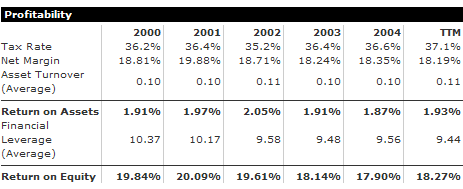
We took an initial position today in SNV. It has a projected average return of 18.7% and a RQR quality rating of 70.1. The director of investor relations spoke at the Better Investing National Conference in Atlanta. Two key points from the presentation were that SNV is well managed and the price of banks have been driven down based on concern about bank profitability due to the increase in long term interest rates. SNV has maintained very solid profitability with an return on assets (a key metric for banks) of about 1.9%. Return on equity has been steady aroud 18%. See Morningstar profitability summary below.
 |
Business Description. Synovus Financial Corp., a holding company, provides various financial services. It operates in two segments, Financial Services and Transaction Processing Services (TPS).
The Financial Services segment provides commercial banking services, including commercial, financial, agricultural, and real estate loans; retail banking services, including accepting demand and savings deposits; individual, consumer, installment, and mortgage loans; safe deposit services; leasing services; automated banking and fund transfer services; and bank credit card services. It also provides portfolio management services; securities brokerage; trust services; insurance agency services; financial planning services; asset management services; and investment advisory services.
The TPS segment primarily provides electronic payment processing services in the United States, Canada, Mexico, Honduras, Puerto Rico, and Europe. It also provides back-end processing services to support merchant processing and offers other products and services to support its processing services. In addition, the TPS segment provides commercial printing and related services; programming support and assistance with the conversion of card portfolios to TS2; recovery collections, bankruptcy process and legal account management, and skip tracing services; Internet, Intranet, and client/server software solutions for commercial card management programs; targeted loyalty consulting, as well as travel, gift card, and reward programs; gift card processing services to Japanese clients; prepaid card solutions; and sells and leases computer related equipment associated with its electronic payment processing services. As of April 26, 2005, Synovus operated 41 banks and other Synovus’ offices in Georgia, Alabama, South Carolina, Florida, and Tennessee. The company was formed in 1888 and was formerly known as CB&T Bancshares, Inc. It changed its name to Synovus Financial Corp. in 1989. Synovus is headquartered in Columbus, Georgia.
Occidental Petroleum (OXY)
SSG and PERT A (11-17-2005) | Google “stocks: oxy” | Company Website

We took an initial position today in OXY (and increased our existing position in Chevron). This is our second energy stock. For an assessment of OXY, see the October 15 report by McDep Associates. OXY has the lowest ratio of market capitalization and debt to present value (“McDep” ratio) making it the best value among the medium and large cap independent oil and gas producers. Value Line rates its financial strength A+. OXY pays a 1.5% dividend.
Business Description. Occidental Petroleum Corporation primarily engages in the exploration for, development, production, and marketing of crude oil and natural gas in the United States, Latin America, and Middle East. As of December 31, 2004, the company had proved reserves of 2,489 million barrels of oil and gas equivalent. Occidental Petroleum also manufactures and markets basic chemicals, such as chlorine, caustic soda, potassium chemicals, and their derivatives; vinyls, including polyvinyl chloride (PVC), vinyl chloride monomer, and ethylene dichloride; and performance chemicals, including chlorinated isocyanurates, resorcinol, antimony oxide, mercaptans, and sodium silicates. PVC resins are used in piping, electrical insulation, external construction materials, flooring, medical and automotive products, and packaging. The company markets its chemical products to industrial users or distributors through its own sales force. Occidental Petroleum is headquartered in Los Angels, California.